|
Start This Feature At
Its Beginning |
|
|
about kokopelli
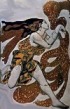
These two dancing figures look like they're having a terrific time, don't
they? They're two depictions of the American Indian god, Kokopelli.
Who is Kokopelli? Kokopelli is a fertility deity venerated today by
numerous Native American tribes. He was also venerated by the ancient
Puebloan peoples of the American Southwest, peoples called the Anasazi or
ancient ones by the present-day Navajo. His history may well go as
far back as 1,200 BCE and his mythology may have evolved until as late as circa 1,200 CE.
Kokopelli still plays an active role in many aspects of Native American life
today.
He is important to such tribes as the Hopi, Zuni, Taos, Acoma, and others. His
chief role among these tribes is to preside over childbirth and
agriculture.
Different tribes ascribe different qualities to Kokopelli, but
no matter how their idea of him may differ, all the tribes who follow Kokopelli accept him as
the same god. Kokopelli is usually (but not always) portrayed with a humpback while
dancing and playing a flute. No matter what his proclivities may be
according to different tribes, Kokopelli is seen as a trickster god who represents the
spirit of music. He flirts with and seduces women, presides over the
reproduction of game animals, and wanders from place to place like a
traveling salesman, playing tricks and practical jokes on people and having
a good time for himself.
Kokopelli especially likes to take advantage of the fairer sex. The Hopi
believe that the swelling on Kokopelli's back is actually a representation
of an unborn child, and that he distributes unborn children to women. For
this reason, he is frequently avoided by young Hopi women.
Among the tribes, he often plays a part in rituals related to marriage and
fertility ceremonies such as maize-grinding, maize being the
food of life. Some tribes believe that Kokopelli's flute playing brings the
return of Spring or rain, and others that the hump is a bag of seeds.
 Scholars
vary in their opinions, too. Because of his connection with animals, some
archeologists and sociologists believe that the flute he carries is actually
a blowgun. Some believe that the protrusions on his head are actually
feathers, antennas, or a collection of vary large phalluses. Scholars
vary in their opinions, too. Because of his connection with animals, some
archeologists and sociologists believe that the flute he carries is actually
a blowgun. Some believe that the protrusions on his head are actually
feathers, antennas, or a collection of vary large phalluses.
Another theory is that Kokopelli is a humanoid insect, and indeed, many early
depictions of Kokopelli make him look like an insect. In this theory, the
name Kokopelli is a meld of the word Koko, a Hopi and Zuni
deity, and the word pelli,
the Hopi and Zuni word for the desert robber fly, an insect with a big
nose and a hump back, famous for its sexual energies. (See a humanoid
insect-like depiction of Kokopelli at the left.)
kokopelli and electricka's
muses
What is Kokopelli's connection with the muses? As with different tribes
and scholars, Kokopelli holds many different associations for Electricka and
her cohorts. For example, Greek muses are gods, as is Kokopelli; and the
flute he plays suggests the role of recording in the field of music.
To Electricka and her muses, however, Kokopelli is most associated with
recording arts and technologies in all their varied forms. Why?
Kokopelli is one of the most easily recognized figures in the
Southwestern United States, or indeed, anywhere in the world.
He appears on petroglyphs and pictographs everywhere. Kokopelli is one
of the kachina dolls sold to tourists. His image appears on pottery,
carpets, signs, statues, and in art all over the Four Corners area of
Arizona, Colorado, New Mexico, and Utah. In recent years, a phallus-free
version of Kokopelli has been adopted as a broader symbol of the
Southwestern United States as a whole; and his image adorns countless items
such as T-shirts, ball caps, and key chains.
Viewed from an artistic point of view, there could hardly be a figure
that has been more recorded than Kokopelli. His image is carved into stone;
it records and
expresses ideas and beliefs that are thousands of years old. It reminds us
of antediluvian images applied to prehistoric cave walls, yet it is an image
that is as vibrant today as it was archaically. Kokopelli's image is having
a good time wherever it shows up. That's why Electricka and
her muses have made Kokopelli's picture the symbol of the recording arts
features you find at her web site.
more about kokopelli
Explore Kokopelli further at these web sites:
- Explore Kokopelli legends, music, history, imagery, ceremonies, and
lore at the web site called Kokopelli Legends & Lore:
tap or click here
- Learn about Kokopelli mythos, origins, and history. Find references to
the subject of Kokopelli at the Wikipedia page about Kokopelli:
tap or click here
|